
Why Your Current Marketing ROI Is Underperforming
Marketing teams are under immense pressure to deliver measurable results. Yet, according to First Page Sage's SEO ROI statistics, the average return on investment for SEO can vary wildly, often hampered by inefficient processes and slow execution. Many organizations are stuck in manual workflows that simply can't keep up.
Content creation is slow, keyword research is a guessing game, and optimization is inconsistent. This leads to wasted budget, missed opportunities, and a marketing engine that fails to generate the expected returns. For teams ready to scale, the solution is shifting from manual effort to AI-driven strategy.
Ubenie is designed to solve this exact problem. It's an AI-powered traffic builder that automates the entire SEO and content marketing lifecycle, enabling teams to improve marketing ROI by focusing on strategy instead of manual tasks.
The Investment: Moving Beyond Manual Marketing Efforts
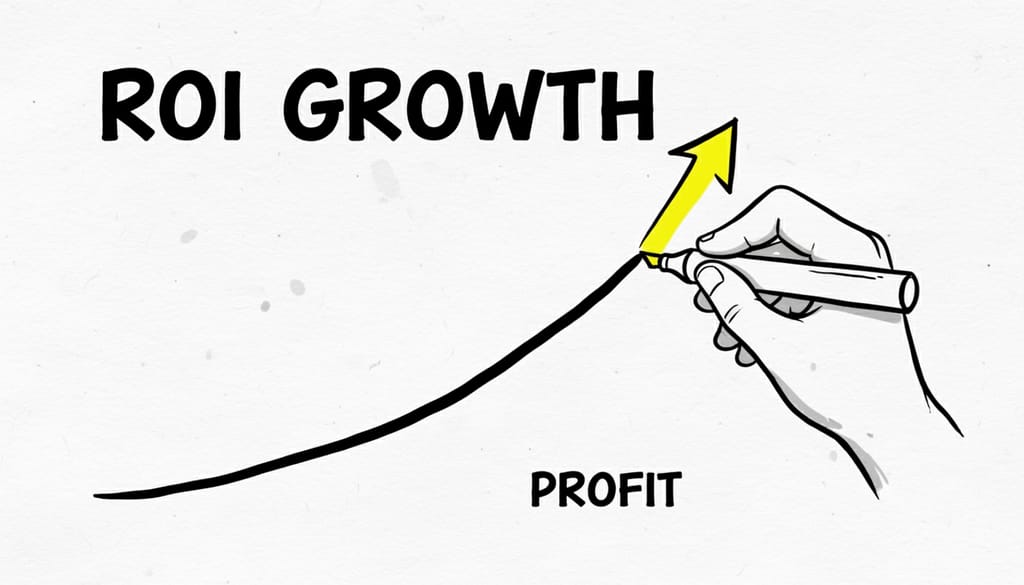
Viewing AI-powered content automation as an expense is a mistake. It's a strategic investment in efficiency, scalability, and predictable growth. The real question isn't whether you can afford to adopt AI, but whether you can afford not to.
Traditional marketing often follows a version of the 70/20/10 rule: 70% of resources on proven tactics, 20% on emerging ones, and 10% on experimental bets. AI platforms like Ubenie supercharge the 70% by automating the creation of high-performing, SEO-optimized content at scale, freeing up teams to focus on the innovative 20% and 10%.
This isn't about just any content; it's about strategic content marketing. Understanding the difference is crucial, as outlined in our guide on Content Marketing vs Digital Marketing: The Core Distinction. Ubenie focuses on the content engine that drives your entire digital strategy.
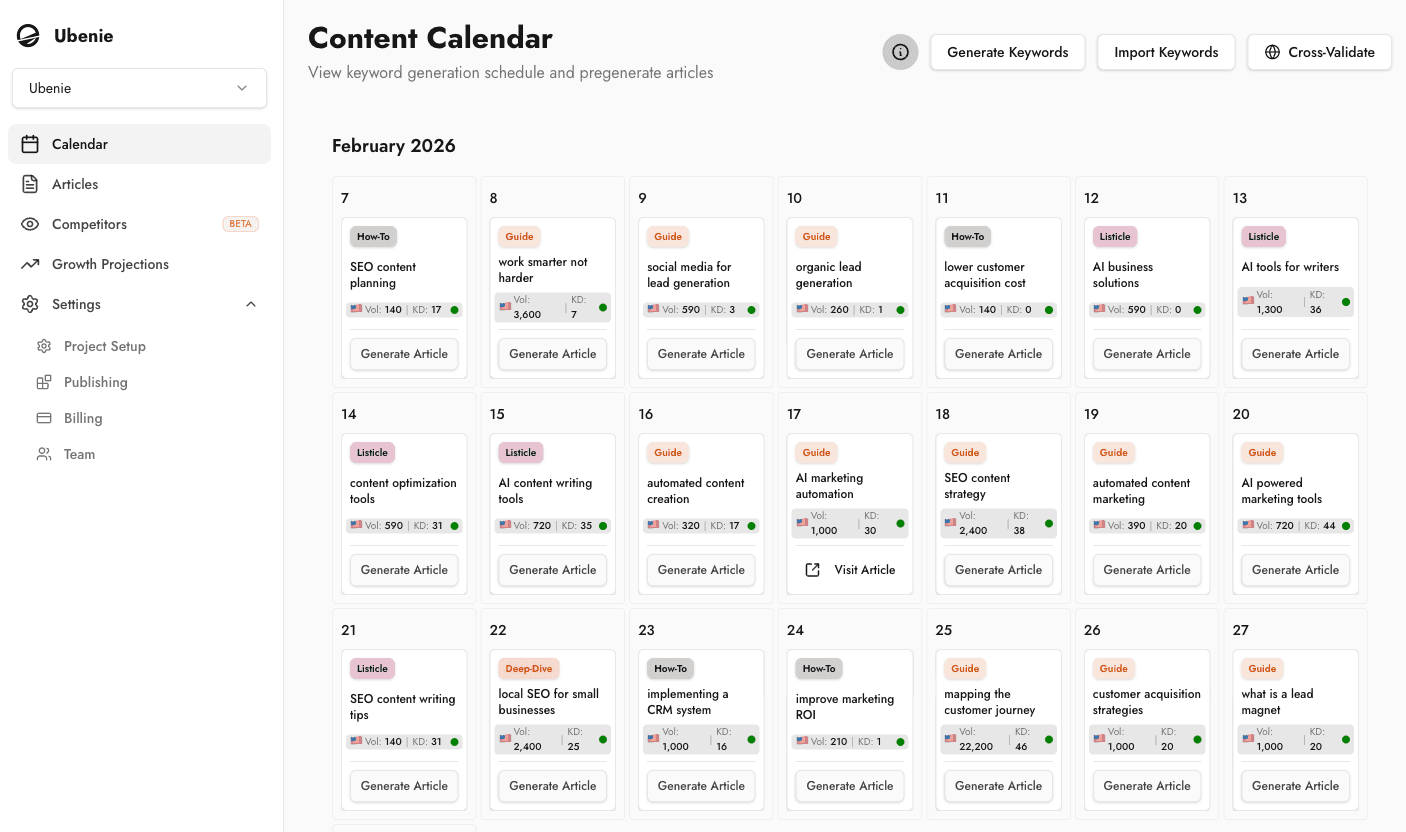
The initial step is straightforward. Ubenie's Onboarding Process is designed for speed and simplicity. You describe your business, and our AI immediately begins identifying high-potential keyword opportunities and generating content tailored to your audience. This eliminates the steep learning curve and lengthy setup associated with other marketing tools.
This investment reallocates your most valuable resource—your team's time—from tedious production to high-impact strategic planning. It's a fundamental shift in how marketing gets done.
Cost Breakdown: The True Price of Content Marketing

To truly understand the value of automation, marketers must first analyze the full cost of the status quo. These costs are both direct and indirect, and they add up quickly.
Direct Costs
Direct costs are the line items you see on a budget sheet. For a typical content marketing program, this includes salaries for in-house writers, editors, and SEO specialists. If you don't have an in-house team, you're paying for freelancers or agencies, where a single blog post can cost hundreds or even thousands of dollars.
Then there are the software subscriptions. A robust marketing stack often includes separate tools for keyword research like Ahrefs or Semrush, a content management system, analytics platforms, and project management software. These monthly fees create a significant fixed overhead.
Indirect Costs
Indirect costs are more subtle but far more damaging to your ROI. The primary indirect cost is time. The hours your team spends on manual research, writing, editing, and formatting are hours not spent on strategy, customer engagement, or campaign analysis.
This manual effort also introduces the cost of inconsistency. Quality can vary from one article to the next, and SEO best practices might be overlooked. This leads to a portfolio of content with uneven performance, dragging down your overall Search Rankings.
Finally, there's the opportunity cost. While your team is bogged down in a slow Content Workflow, your competitors are publishing content faster, capturing valuable keywords, and winning over your target audience. Every day of delay is a day you're losing ground.
Here’s a simplified look at how the costs compare:
| Cost Factor | Manual Content Workflow | Ubenie Automated Workflow |
|---|---|---|
| Personnel | High (Salaries, Freelance Fees) | Low (Reduced need for dedicated writers) |
| Software | High (Multiple subscriptions) | Low (All-in-one platform) |
| Time-to-Publish | Slow (Weeks or Months) | Fast (Hours or Days) |
| Scalability | Low (Limited by headcount) | High (Virtually unlimited) |
| Consistency | Variable | High (Built-in best practices) |
Ubenie consolidates these functions, drastically reducing both direct and indirect costs while transforming the entire content creation process into a streamlined, automated engine.
Benefits Analysis: Quantifying the Gains of Automation

Investing in AI automation with Ubenie delivers benefits that directly improve marketing ROI. These advantages can be broken down into tangible, measurable gains and equally valuable intangible benefits.
Tangible Benefits
Tangible benefits are the metrics you can track on a dashboard. The most significant is the increase in organic traffic. Ubenie automatically researches low-competition, high-intent keywords and generates content designed to rank for them. This leads to a sustainable flow of qualified visitors to your website.
This traffic translates directly into more leads and sales. By targeting keywords your real customers are searching for, Ubenie ensures the audience you attract is already interested in your product or service. You can track this conversion lift in tools like Google Analytics.
Another key benefit is a dramatic reduction in Cost Per Acquisition (CPA). Organic traffic from SEO is highly cost-effective compared to paid advertising. As your Ubenie-generated content library grows, you build a long-term asset that continuously generates leads without ongoing ad spend.
Ubenie also ensures every piece of content is technically optimized for search engines. This includes perfect Headline Optimization and compelling Meta Descriptions to maximize click-through rates from search results. It also incorporates Structured Ranking Elements like lists, tables, and proper heading hierarchies to help Google understand and favor your content.
Intangible Benefits
Intangible benefits are about strategic advantage. The most important is speed and scalability. Ubenie allows a small team to produce the content volume of a large agency, enabling you to dominate niche topics and respond quickly to market trends.
Brand consistency is another major advantage. Ubenie maintains a consistent tone and quality across all content, reinforcing your brand identity and building trust with your audience. This moves beyond old marketing adages like the "7 times 7 rule" (a prospect needs to see a message seven times) by ensuring every touchpoint is high-quality and on-brand.
Furthermore, automating content creation frees your marketing team from the production line. They can elevate their roles to focus on higher-value activities: building community, analyzing performance data, and developing overarching campaign strategies. This boosts team morale and fosters innovation.
Finally, you gain a significant competitive edge. While competitors are stuck in slow, manual workflows, your business can build a powerful content moat that is difficult for others to replicate. You're not just creating content; you're building a scalable system for sustained organic growth.
ROI Calculation: A Practical Formula for Success
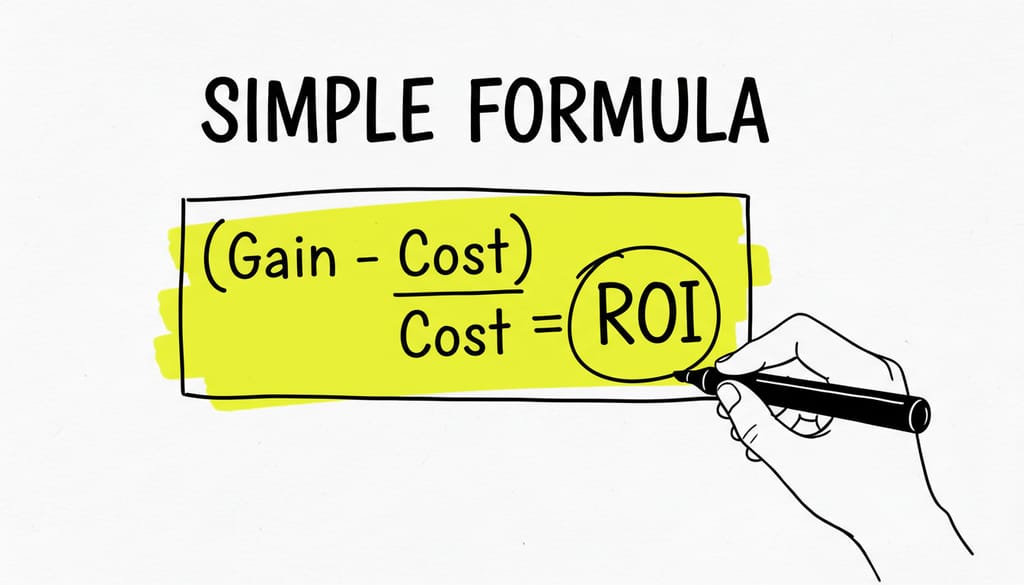
Calculating the return on your marketing investment is essential. The basic formula is straightforward: (Gain from Investment - Cost of Investment) / Cost of Investment. The result is a percentage that shows how much you've earned for every dollar spent.
When applying this to Ubenie, the calculation becomes compelling.
Cost of Investment: This is your Ubenie subscription fee. It's a predictable, fixed monthly cost that replaces the variable and often high costs of freelancers, agencies, and multiple software tools.
Gain from Investment: This is the value of the new business generated through the organic traffic Ubenie creates. To calculate this, you need a few key metrics:
- Increase in Monthly Organic Traffic: Track the growth in website visitors from search engines.
- Website-to-Lead Conversion Rate: What percentage of those visitors become leads (e.g., fill out a form, sign up for a trial)?
- Lead-to-Customer Conversion Rate: What percentage of leads become paying customers?
- Average Customer Lifetime Value (CLV): What is the total revenue a new customer brings to your business over time?
Let’s run a hypothetical example for a small business:
- Ubenie Cost: $300/month
- Traffic Increase: 1,500 new organic visitors/month after 6 months
- Website-to-Lead Rate: 2% (30 new leads/month)
- Lead-to-Customer Rate: 10% (3 new customers/month)
- Average CLV: $1,000
Calculation:
- Monthly Gain: 3 new customers * $1,000 CLV = $3,000
- Monthly Cost: $300
- ROI: ($3,000 - $300) / $300 = $2,700 / $300 = 9
In this scenario, the ROI is 900%. For every $1 invested in Ubenie, the business generates $9 in return. This demonstrates the power of creating a scalable content engine.
This data-driven approach is far more effective than relying on outdated marketing concepts. For instance, the 3-3-3 rule in marketing (get your message across in 3 seconds, in a 3-word headline, with 3 bullet points) speaks to the need for immediate impact. Ubenie's Headline Optimization is designed specifically to achieve this, capturing attention in crowded search results.
Similarly, concepts like the 7-11-4 rule (build trust through 7 hours of content, across 11 touchpoints, in 4 locations) highlight the importance of consistent presence. Ubenie makes achieving this scale of content possible for any business.
Hidden Costs of Inaction: The Risk of Sticking with the Status Quo
The most dangerous costs are often the ones you don't see. Choosing to stick with a manual, inefficient content process carries significant hidden costs that can cripple growth over time.
The biggest is market share erosion. While your team struggles to publish a few articles a month, AI-powered competitors are publishing dozens. They are capturing keyword rankings, building topical authority, and becoming the go-to resource in your industry. Once a competitor establishes this dominance, it becomes exponentially harder and more expensive to win it back.
Another hidden cost is team burnout. Talented marketers and strategists don't want to spend their days on repetitive production tasks. Forcing them into a content assembly line leads to frustration, decreased creativity, and high employee turnover. Replacing and training new team members is a massive drain on resources and institutional knowledge.
There's also the cost of stagnant data. Without a consistent flow of new content to test and analyze, your understanding of your audience and the market will not evolve. You miss out on valuable insights about which topics resonate, what questions customers are asking, and how search intent is changing. Ubenie's automated approach provides a constant stream of performance data to sharpen your entire marketing strategy.
Inaction is not a neutral choice; it's an active decision to fall behind. The compounding effect of these hidden costs makes it one of the most expensive decisions a marketing leader can make.
Value Comparison: Ubenie vs. Traditional SEO Agencies & Freelancers
When looking to scale content, businesses typically consider SEO agencies or freelance writers. While they can be effective, they present a different value proposition compared to an AI-powered platform like Ubenie.
SEO Agencies:
- Pros: Offer comprehensive strategy and expertise.
- Cons: Very expensive, with retainers often starting at several thousand dollars per month. They are also slow to execute, and you are often one of many clients, receiving limited attention. Communication can be a bottleneck.
Freelance Writers:
- Pros: Can be more affordable for one-off projects.
- Cons: Quality is highly variable. Finding and managing good freelancers is a time-consuming job in itself. They typically lack deep SEO expertise, and ensuring content is fully optimized requires an additional layer of management and review. Scaling with freelancers is a logistical nightmare.
Ubenie:
- Pros: Combines affordability, speed, and scalability. It delivers high-quality, SEO-optimized, Human-like Content on a predictable schedule. The system is designed to build a cohesive content strategy with automated Internal Linking suggestions and consistent optimization. It puts the power of an entire content team and SEO agency into a single, easy-to-use platform.
Ubenie isn't just a cheaper alternative; it's a fundamentally different model. It empowers your team to own and control your SEO strategy without being dependent on expensive third parties or unreliable freelancers. It's about building an in-house asset, not just renting external services.
Success: Ubenie users are empowered to become their own SEO experts. The platform automates the technical complexities, allowing teams to focus on the strategic direction of their content and build a powerful, long-term traffic-generating asset.
A Decision Framework for Adopting AI in Your Marketing
Ready to improve marketing ROI with AI? Here’s a simple framework to guide your decision-making process and ensure a successful implementation.
Step 1: Audit Your Current Content Workflow.
Before you can improve, you must understand your baseline. Map out your current process from idea to publication. How long does it take? Who is involved? What are the bottlenecks? Calculate your current content production cost, including salaries, tools, and freelance fees.
Step 2: Define Your Goals and KPIs.
What do you want to achieve? Be specific. Your goals might include increasing organic traffic by 50% in six months, reducing CPA by 30%, or ranking for a specific set of strategic keywords. Clear goals will help you measure the success of your investment.
A solid strategy starts with a plan. You can use our guide to building Your Ultimate Content Marketing Plan Template to structure your objectives.
Step 3: Evaluate AI Solutions Based on Your Needs.
Not all AI tools are created equal. Look for a solution that addresses your entire workflow, not just one piece of it. An end-to-end platform like Ubenie, which handles keyword research, content generation, optimization, and scheduling, provides far more value than a simple AI writer. This is especially true for small businesses, which need an all-in-one growth engine as detailed in our guide to Content Marketing for Small Business.
Step 4: Run a Pilot Program.
Start with a focused pilot project. Choose a specific product line, service, or topic cluster you want to target. Use Ubenie to generate a set of articles for this topic and measure their performance against your baseline KPIs. This allows you to prove the value of the platform with real data before rolling it out across the entire organization.
Step 5: Scale and Integrate.
Once the pilot demonstrates positive ROI, it's time to scale. Integrate the AI platform fully into your marketing operations. Train your team not as content creators, but as content strategists and editors who guide the AI. This shift in roles is the key to unlocking the full potential of automation.
Frequently Asked Questions
What is the most common mistake when trying to improve marketing ROI?
The most common mistake is focusing too much on short-term, high-cost channels like paid ads while neglecting the long-term asset building of SEO and content marketing. True, sustainable ROI comes from creating a content engine that generates organic traffic and leads for years to come, which is where automation excels.
How long does it take to see ROI from SEO and content marketing?
While some quick wins are possible, SEO is a long-term strategy. Typically, it takes 4-6 months to start seeing significant traction and measurable ROI from a consistent content marketing effort. The compounding nature of SEO means that the returns grow exponentially over time as your content library and domain authority expand.
Can AI really replace human marketers for content creation?
AI is not about replacement; it's about augmentation. AI platforms like Ubenie handle the heavy lifting of research, drafting, and optimization, which frees up human marketers to focus on strategy, creativity, editing, and understanding the customer's nuanced needs. The best results come from a partnership between human expertise and AI efficiency.
Is automating content marketing suitable for all types of businesses?
Yes, virtually any business that relies on online visibility can benefit. Whether you are a small business, a startup, an e-commerce store, or a large enterprise, automating content creation allows you to scale your reach, build authority, and attract qualified customers more efficiently than manual methods.
What's the first step to calculating my current marketing ROI?
The first step is to diligently track your costs and your returns. For costs, sum up all expenses related to a specific marketing campaign or channel (e.g., ad spend, software fees, salaries). For returns, measure the revenue generated directly from that campaign, often by tracking conversions and calculating Customer Lifetime Value (CLV).
Tired of struggling with SEO and content marketing? Automate your traffic growth and focus on what you do best. Visit our website to discover how we can help you achieve higher search rankings and more leads.
Article created using Ubenie.