
As a small business owner, you wear many hats: CEO, marketer, customer service rep, and everything in between. In this whirlwind of responsibilities, marketing can often feel like shouting into a void. You've built a fantastic website, but the visitors aren't coming. You have a great product, but nobody seems to be finding it online. This is a common and frustrating reality, but it's not a dead end. The problem often boils down to a single, foundational element of digital marketing: Keyword Research. It's the process of understanding the exact words and phrases your potential customers are typing into Google. Getting this right is like being handed a map to your customers' front doors.
For many, the term itself sounds technical and intimidating, reserved for SEO experts with expensive tools. But what if it didn't have to be? What if you could understand the core principles and leverage modern technology to find the exact terms that will bring qualified, ready-to-buy customers to your site? This guide is designed to demystify keyword research for small business. We'll walk you through the essential concepts, practical strategies, and powerful tools that can transform your online presence from invisible to unmissable. This isn't just about SEO theory; it's about building a sustainable engine for growth, and it all starts with the right words. For a broader overview of how this fits into your overall strategy, consider exploring The Ultimate Beginner's Guide to SEO for Small Business.
Why Keyword Research is a Game-Changer for Small Businesses

Before diving into the 'how,' it's crucial to understand the 'why.' Why should you, a busy entrepreneur, dedicate precious time to keyword research? Simply put, it’s the most direct line you have to your customer's mind. It moves your marketing from a guessing game to a data-driven strategy. When you master keyword research, you stop creating content you think your audience wants and start creating content you know they are actively searching for.
This process is fundamental to improving your search rankings, which directly impacts your visibility. Consider that the first page of Google captures the vast majority of search traffic clicks. If you're not there, you're effectively invisible to a huge segment of your potential market. For small businesses, this visibility is paramount. You don't have the massive brand recognition of a multinational corporation, so you must win in the trenches of search engine results pages (SERPs). Statistics show that 46% of all Google searches are for local businesses, which means nearly half of the people searching are looking for someone just like you in their area. Without targeting the right keywords, they'll find your competitors instead.
Beyond Traffic: The Business Intelligence Goldmine
Keyword research offers insights that extend far beyond SEO. It's a form of market research that tells you:
- What Your Customers Need: The questions they ask and the problems they face reveal their pain points. Content that addresses these directly builds trust and authority.
- The Language They Use: Do they search for "affordable accountant" or "small business bookkeeping services"? Using your customer's vocabulary makes your marketing more relatable and effective.
- Market Trends: Are people suddenly searching for "eco-friendly packaging for small business"? Keyword trends can signal new product opportunities or shifts in consumer demand.
- Competitive Landscape: Understanding which keywords your competitors rank for shows you their strategy and reveals gaps you can exploit.
By aligning your website's content with these discovered terms, you attract 'qualified traffic.' These aren't just random visitors; they are people with a specific need or question that your business can solve. This targeted approach leads to higher engagement, better conversion rates, and ultimately, a more significant return on your marketing investment. It's the difference between a billboard on a random highway and a stall at a niche farmer's market where everyone is looking for exactly what you sell.
The Core Concepts: Understanding Search Intent and Keyword Types
To effectively conduct keyword research, you need to grasp two fundamental concepts: what people are looking for (User Intent) and the types of phrases they use (keyword types). Mastering this combination is the key to choosing keywords that don't just bring traffic, but bring the right traffic.
Cracking the Code of User Intent
User Intent is the 'why' behind a search query. It’s the ultimate goal a person has when they type something into Google. Search engines have become incredibly sophisticated at deciphering this intent to provide the most relevant results. If your content doesn't match the intent of the keyword you're targeting, you have almost no chance of ranking. There are four primary types of search intent:
- Informational: The user is looking for information. They want to know something, learn how to do something, or find an answer to a question. These queries often start with "how to," "what is," "why is," or are simply a topic like "small business tax deductions."
- Navigational: The user wants to go to a specific website or location. They already know where they want to go and are using the search engine as a shortcut. Examples include "Ubenie login," "Facebook," or "Chase bank."
- Transactional: The user is ready to make a purchase. They are looking to buy a product or service. These queries include words like "buy," "deal," "discount," "order," or a specific product name like "buy iPhone 15."
- Commercial Investigation: The user intends to buy in the future but is currently in the research and comparison phase. They are looking for reviews, comparisons, and the best options. Examples include "best CRM for small business," "Semrush vs Ahrefs," or "Ubenie reviews."
For most small businesses, focusing on informational and commercial investigation keywords is the sweet spot for Blog Content. This is where you can provide value, build trust, and guide potential customers toward a transactional decision. You answer their questions and position your business as the expert solution.
The Anatomy of Keywords: Head, Body, and Long-Tail
Keywords aren't all created equal. They can be broken down by their length and specificity, which generally correlates with their search volume and competitiveness.
| Keyword Type | Description | Example | Search Volume | Competition | Conversion Potential |
|---|---|---|---|---|---|
| Head Terms | 1-2 words, very broad and generic. | "marketing" | Very High | Very High | Low |
| Body Keywords | 2-3 words, more specific, a good middle ground. | "content marketing" | High | High | Medium |
| Long-Tail Keywords | 4+ words, highly specific and targeted. | "content marketing for small business" | Low | Low | Very High |
For small businesses, long-tail keywords are pure gold. While they have lower individual search volumes, they are far less competitive and attract a highly motivated audience. Someone searching for "how to find keywords for a local plumbing business" is much closer to becoming a customer than someone just searching for "SEO." The intent is clearer, the competition is lower, and the traffic is more qualified. Cumulatively, targeting hundreds of these specific long-tail keywords can drive more valuable traffic than trying to rank for a single, highly competitive head term.
Building Your Initial Keyword List: Brainstorming and Seed Keywords

Now that you understand the theory, it's time to get practical. The first step in any keyword research project is to create a foundational list of topics and terms related to your business. This isn't about finding perfect, data-backed keywords just yet; it's about brainstorming and generating a broad list of possibilities. These initial ideas are called "seed keywords."
Step 1: Think Like Your Customer
Put yourself in your ideal customer's shoes. Forget about your industry jargon for a moment. What would they type into Google if they were looking for a solution you provide? Ask yourself these questions:
- What problems does my product or service solve?
- What are the main topics or categories related to my business?
- What questions do customers ask me most often?
- What terms would a complete beginner use to describe what I do?
Let's say you own a local, artisanal bakery. Your seed keywords might start with:
sourdough breadcustom birthday cakesgluten-free pastrieslocal bakery near mewedding cake consultation
This initial list forms the basis for all your future research. Don't filter yourself at this stage; write down everything that comes to mind.
Step 2: Expand Your List with Niche Communities
Your customers are already online talking about their needs and problems. You just need to find them. Online communities are a treasure trove of authentic language and keyword ideas.
- Reddit: Find subreddits related to your industry. For the bakery, you might look at r/Baking, r/Sourdough, or the subreddit for your specific city. Look at the post titles and comments. What questions are people asking? What frustrations are they voicing? You might find long-tail keywords like "how to store sourdough bread to keep it fresh" or "best non-dairy frosting for cakes."
- Quora: Similar to Reddit, Quora is a question-and-answer platform. Search for your seed keywords and see what conversations pop up. The questions themselves are often perfect long-tail keywords.
- Facebook Groups: Join groups where your target audience hangs out. Pay attention to the discussions. These are unfiltered insights into your customers' minds.
Step 3: Automate the Foundation
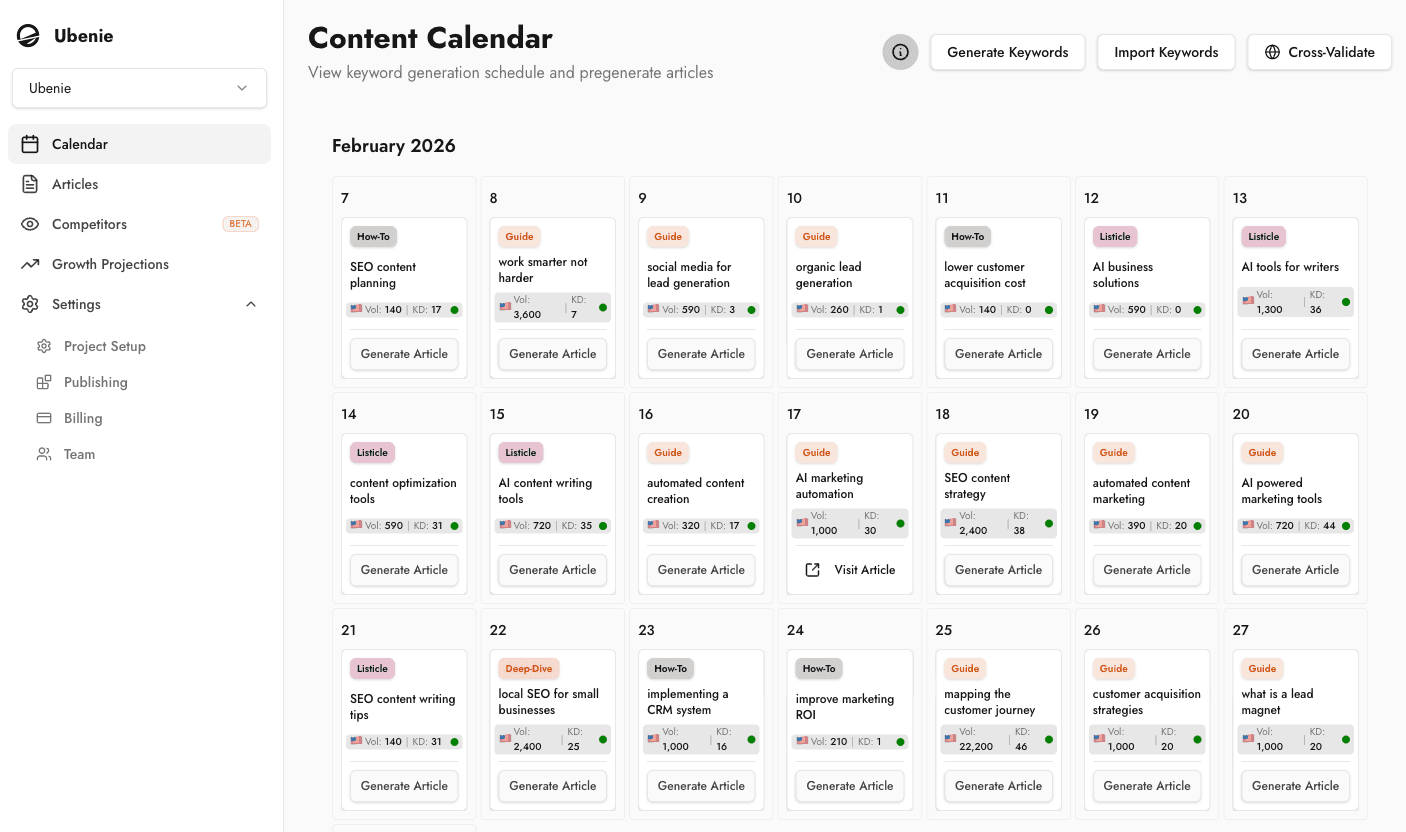
This brainstorming process is essential, but it can be time-consuming. This is where modern platforms can provide a massive advantage. For example, a user of Ubenie doesn't start with a blank slate. During onboarding, you simply describe your business, your services, and your target audience. The AI then takes this information and automatically generates a list of relevant seed keywords and high-potential topic clusters. It analyzes your niche and identifies low-competition, high-intent terms that real customers are searching for. This automates the foundational step, allowing you to move directly to strategy and content creation, saving you hours of manual brainstorming and guesswork.
Note: Your initial list should be extensive. Aim for at least 20-30 seed keywords and phrases before you move on to the next phase of analysis and validation using keyword research tools.
Essential Keyword Research Tools for Every Budget
Once you have your brainstormed list of seed keywords, it's time to use specialized tools to expand that list, gather data, and validate your ideas. These tools provide crucial metrics like search volume (how many people search for a term per month) and keyword difficulty (how hard it is to rank for that term). They can be categorized into free, freemium, and premium options, making keyword research accessible regardless of your budget.
Free and Freemium Tools (The Perfect Starting Point)
For those just starting out or on a tight budget, these tools provide a wealth of information without any financial commitment.
- Google Keyword Planner: Part of the Google Ads platform, this is the classic free tool. While it's designed for advertisers, it's invaluable for SEO. You can enter your seed keywords to discover new ideas and see estimated monthly search volume ranges. To access it, you'll need a Google account, but you don't have to run an active ad campaign.
- Google Trends: This tool is excellent for understanding the seasonality and relative popularity of keywords over time. You can compare the search interest of multiple terms and identify emerging trends in your industry.
- AnswerThePublic: This brilliant tool visualizes search questions. You enter a keyword, and it generates a cloud of questions (who, what, when, where, why, how), prepositions, and comparisons that people are searching for. It's a goldmine for finding informational and long-tail keyword ideas for your blog content.
Premium Tools (For Deeper Analysis)
As your business grows, investing in a premium tool can provide a significant competitive advantage. These platforms offer more accurate data, in-depth competitor analysis, and a suite of features that go beyond basic keyword discovery.
- Ahrefs: A favorite among SEO professionals, Ahrefs offers a massive keyword database, highly accurate difficulty scores, and powerful competitor analysis features. Its 'Keywords Explorer' tool allows you to see what keywords your competitors rank for that you don't, a process known as a keyword gap analysis.
- Semrush: Another industry giant, Semrush provides a comprehensive toolkit covering everything from keyword research and rank tracking to content marketing and social media management. Its 'Keyword Magic Tool' is fantastic for generating huge lists of related keywords and filtering them by intent, volume, and difficulty.
- Moz Keyword Explorer: Known for its user-friendly interface, Moz offers solid keyword data and unique metrics like 'Organic CTR' and 'Priority Score' to help you choose the best keywords to target.
The AI-Powered Alternative: From Manual Labor to Automation
Using these tools, whether free or paid, involves a significant manual effort: brainstorming, entering seeds, filtering massive lists, analyzing competitors, and finally, deciding what to write about. This is a complex and time-consuming workflow. The decision often comes down to a choice between DIY, hiring an agency, or using a new breed of AI solutions. As detailed in this comparison of Affordable SEO for Small Business: DIY vs. Agency vs. AI, each path has its pros and cons.
This is where a platform like Ubenie fundamentally changes the game. Ubenie isn't just a tool; it's an automated SEO and content engine. It replaces the need for you to manually operate tools like Ahrefs or Semrush. Ubenie's AI performs the entire keyword research process for you. It identifies the most strategic, low-competition keywords for your specific business and then automatically generates Google-optimized blog posts designed to rank for them. It streamlines the entire workflow from research to publication, freeing you to focus on running your business.
Analyzing Keywords: How to Choose the Right Terms to Target

Having a long list of potential keywords is great, but the real skill lies in selecting the right ones to target. Chasing the wrong keywords can waste months of effort with little to no return. A successful keyword strategy involves a careful balancing act between four key metrics: search volume, keyword difficulty, relevance, and commercial intent.
1. Search Volume
Search volume indicates how many times a keyword is searched for in a given month. It's a measure of demand. While it's tempting to go after keywords with tens of thousands of monthly searches, these are often highly competitive and too broad. For a small business, a keyword with 50-200 monthly searches can be far more valuable if it's highly relevant and has low competition. Remember the long-tail strategy: it's better to capture 100% of the traffic for a keyword with 100 monthly searches than 0.1% of the traffic for a keyword with 100,000 searches.
2. Keyword Difficulty (KD)
This metric, provided by tools like Ahrefs and Semrush, estimates how hard it will be to rank on the first page of Google for a given keyword, usually on a scale of 0-100. It's calculated by analyzing the number and quality of backlinks to the current top-ranking pages. As a small business with a newer website, you should focus on keywords with a low KD score (typically under 30, but this varies by industry). This is your secret weapon to bypass established competitors and gain an initial foothold in the search results.
3. Relevance
This is the most important metric, yet it's the one that requires human judgment. Ask yourself: does this keyword perfectly align with the product or service I offer? Will the person searching for this term be happy with what they find on my page? A keyword can have high volume and low difficulty, but if it's not relevant to your business, the traffic it brings will be worthless. Irrelevant traffic leads to a high bounce rate, which signals to Google that your page isn't a good result, ultimately hurting your rankings.
4. Commercial Intent
Finally, consider the potential for a keyword to lead to a sale. As we discussed with user intent, some keywords are more commercially valuable than others. Keywords with transactional or commercial investigation intent are more likely to convert. For example, the keyword "best lightweight running shoes for beginners" has higher commercial intent than "history of running shoes." According to a study by Grow and Convert, informational keywords tend to have lower conversion rates than keywords with clear purchase intent, though they are crucial for building an audience. Their analysis found that bottom-of-the-funnel keywords can have conversion rates of 10% or higher, while informational content might convert at less than 1%. Your content strategy should include a mix, but prioritizing keywords that signal an intent to buy can lead to faster business results.
Performing Competitor Analysis is a critical part of this stage. Look at the top-ranking pages for your target keyword. Are they massive corporations or small businesses like yours? Are they blog posts, product pages, or videos? This analysis tells you what Google expects to see for that query and helps you gauge your true chances of ranking.
Success: The ideal keyword for a small business is a sweet spot: decent search volume, low keyword difficulty, high relevance to your core offering, and clear user intent that you can satisfy.
Advanced Strategies: Uncovering Hidden Keyword Gems
Once you've mastered the fundamentals, you can employ more advanced techniques to uncover keyword opportunities your competitors have overlooked. These strategies help you find ultra-specific, high-intent queries that can drive highly qualified traffic to your site.
Mine Google's SERP Features
Google itself provides a wealth of keyword ideas directly on the search results page. These are not just suggestions; they are based on what millions of users are actively searching for.
- People Also Ask (PAA): This is a box that appears in the search results showing related questions. Each time you click on a question, more will appear. This is an endless source of long-tail, question-based keywords that are perfect for blog post titles or FAQ sections.
- Related Searches: At the bottom of the SERP, Google lists 8-10 related search queries. These can help you discover related topics and alternative phrasing that you might not have considered.
- Google Autocomplete: Start typing a seed keyword into the Google search bar and see what suggestions appear. This provides a real-time look at popular searches related to your term.
Perform a Keyword Gap Analysis
This is a powerful competitor analysis technique offered by premium tools like Semrush and Ahrefs. A keyword gap analysis allows you to enter your domain and the domains of several competitors. The tool will then show you:
- Keywords that all your competitors rank for, but you don't.
- Keywords that some of your competitors rank for, revealing strategic differences.
This process is the fastest way to find proven keywords that are already driving traffic for businesses in your niche. It takes the guesswork out of the equation and provides a clear roadmap of content you need to create to compete effectively.
Leverage Your Own Data with Google Search Console
Google Search Console is a free tool from Google that shows you how your site is performing in search. The "Performance" report is a goldmine for keyword research. It shows you all the queries your site has appeared for, along with your average position, clicks, and impressions. Look for keywords where you have high impressions but a low click-through rate (CTR), especially those ranking on page 2 (positions 11-20). These are your "striking distance" keywords. Your site is already considered relevant for these terms; with a bit of targeted On-Page SEO or by creating more specific AI-Powered Content around that topic, you can often push them onto the first page for a significant traffic boost.
The Future of Keyword Research: Voice Search and AI
Keyword research is not a static discipline. As technology evolves, so do search behaviors. Two of the biggest trends shaping the future of keyword research are the rise of voice search and the increasing sophistication of artificial intelligence. Small businesses that adapt to these changes will have a significant advantage.
The Impact of Voice Search
With the proliferation of smart speakers like Amazon Echo and Google Home, as well as voice assistants on smartphones, more people are searching with their voice. This changes the nature of search queries:
- Queries are Longer and More Conversational: People type "best pizza NYC," but they ask, "Hey Google, what's the best pizza place near me that's open now?"
- Queries are Often Question-Based: Voice searches are predominantly phrased as questions (who, what, where, when, why, how).
To optimize for voice search, your keyword strategy should heavily focus on these natural language, long-tail question keywords. Creating content that directly answers these specific questions, often in a concise FAQ format, makes you eligible to be featured as a voice search result or in a featured snippet on the SERP.
The Role of Artificial Intelligence
AI is revolutionizing every aspect of digital marketing, and keyword research is no exception. While traditional tools provide data, AI provides intelligence and automation.
- Predictive Analysis: AI algorithms can analyze trends and predict which keywords are likely to become popular in the future, giving you a first-mover advantage.
- Topical Clustering: Instead of focusing on single keywords, AI can identify entire topic clusters. This allows you to build authority around a broad subject by creating a pillar page and supporting Blog Content, a strategy that Google's algorithm favors.
- Automation: This is the most significant impact. Platforms like Ubenie use AI to automate the entire workflow. The AI doesn't just find keywords; it understands their intent, analyzes the competitive landscape, and then generates content optimized to rank for those terms. This transforms the role of the small business owner from a manual researcher to a strategic editor and publisher.
Embracing these trends is key to a future-proof Content Marketing strategy. By understanding conversational queries and leveraging AI-powered tools, you can stay ahead of the curve and ensure your business remains visible in an ever-changing search landscape. For a deeper dive into this, see our A Complete Guide to Content Marketing for Small Business.
Conclusion
Keyword research is the bedrock of a successful SEO strategy, especially for a small business. It's the crucial process that connects you with the customers who are actively looking for the solutions you provide. We've journeyed from understanding the fundamental concepts of user intent and keyword types to practical brainstorming, tool usage, and advanced analysis. We've seen how focusing on low-competition, high-relevance long-tail keywords can allow you to compete and win, even against larger, more established players.
The process may seem complex, but it doesn't have to be overwhelming. By starting with free tools, focusing on your customer's perspective, and consistently creating valuable content that matches their search intent, you can build a powerful engine for organic growth. And as technology evolves, AI-powered platforms are making this process more accessible than ever, automating the heavy lifting so you can focus on what you do best: running your business. Don't think of keyword research as a one-time task, but as an ongoing conversation with your market—a conversation that, when done right, will lead to more traffic, more leads, and more growth.
Frequently Asked Questions
How often should I do keyword research?
Keyword research should be an ongoing process. You should conduct a major research project when starting your website or a new campaign. After that, it's beneficial to revisit it quarterly or semi-annually to discover new trends, check on competitor strategies, and find fresh content opportunities based on your site's performance data.
What's a "good" keyword search volume to target?
There's no magic number, as it's highly relative to your industry and niche. For a small or local business, a keyword with 50-250 monthly searches can be incredibly valuable if it's highly relevant and has low competition. It's better to rank #1 for a keyword with 100 searches than #50 for a keyword with 10,000 searches.
Can I rank for competitive keywords as a small business?
It's very difficult to rank for broad, highly competitive keywords (head terms) when you're starting out. A much better strategy is to target less competitive long-tail keywords first. By building authority and a strong backlink profile over time by ranking for these easier terms, you can gradually start competing for more difficult keywords.
What's the difference between keyword research for a blog vs. an e-commerce product page?
For a blog, you'll primarily target informational keywords (e.g., "how to choose a coffee grinder"). The goal is to educate and build trust. For an e-commerce product page, you'll target transactional and commercial investigation keywords (e.g., "buy Baratza Encore coffee grinder" or "best conical burr grinders under $200"). The intent is much closer to a purchase.
How long does it take to see results from keyword research?
SEO is a long-term strategy. After implementing your keyword research by creating and optimizing content, it can take anywhere from 3 to 6 months, and sometimes longer, to see significant movement in your search rankings. Results depend on your industry's competitiveness, the quality of your content, and your website's overall authority.
Ready to put this knowledge into action without the manual grind? Ubenie uses AI to automate this entire process, from finding high-intent keywords to generating rank-ready blog posts. See how you can build your content engine on autopilot at https://ubenie.com/.
Article created using Ubenie.