
In today's competitive digital landscape, over 91% of marketers plan to increase content output this year, but less than half find their processes scalable. This reality underscores a growing need for efficient strategies, making automated SEO services a pivotal solution for businesses striving for sustainable growth. You know SEO is crucial for attracting qualified customers; however, the manual grind of keyword research, content creation, and technical optimization can quickly become a full-time job itself. This persistent challenge, where time and expertise are scarce, positions Ubenie as the practical, autopilot solution for overwhelmed business owners seeking consistent organic traffic without the traditional resource drain.
The Relentless SEO Checklist: A Business Challenge
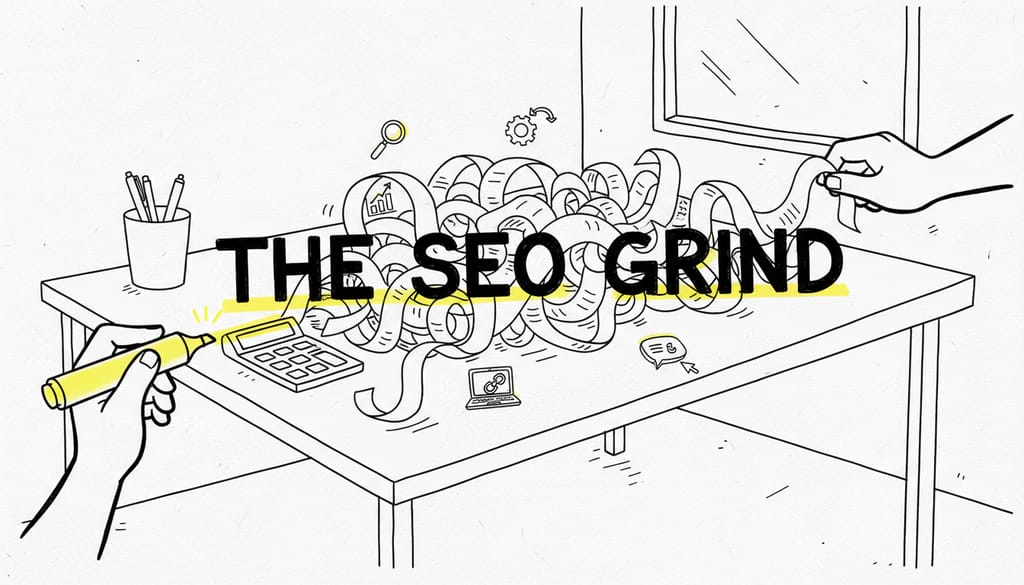
Manually managing SEO presents a relentless checklist of tasks. This multi-disciplinary field demands strategic thinking, creative writing, technical know-how, and persistent outreach. Falling short in one area often undermines efforts in another, leading to a cycle of frustration and stagnant traffic growth. A comprehensive manual SEO strategy involves far more than just writing content; it's a complex ecosystem of interconnected activities requiring consistent attention.
Consider the typical weekly time commitments:
| SEO Task Category | Specific Activities | Time Commitment (Weekly) |
|---|---|---|
| Keyword Research | Identifying target keywords, analyzing competitors, finding long-tail variations, assessing search intent. | 3-5 Hours |
| Content Creation | Brainstorming topics, creating briefs, writing articles, sourcing images, proofreading and editing. | 8-15 Hours |
| On-Page SEO | Optimizing titles and meta descriptions, structuring content with H1/H2/H3 tags, internal linking, image alt text. | 2-4 Hours |
| Technical SEO | Monitoring site speed, ensuring mobile-friendliness, checking for crawl errors, managing sitemaps. | 1-3 Hours |
| Off-Page SEO (Link Building) | Guest posting, broken link building, outreach for backlinks, managing brand mentions. | 4-8 Hours |
| Analysis & Reporting | Tracking rankings in Google Analytics, analyzing traffic, creating performance reports. | 2-4 Hours |
Who has an extra 20-35 hours a week? This significant time drain is precisely the problem platforms like Ubenie solve. Instead of you chasing keywords and dedicating days to writing, Ubenie's AI engine handles the heavy lifting. It identifies high-potential keywords tailored to your business and automatically generates optimized blog posts designed to rank. This transforms a daunting list into a simple review-and-approve process, freeing you to focus on running your business.
Note: These time commitments are estimates for a small, consistent SEO campaign; aggressive growth demands even more resources.
Why Manual SEO Efforts Fall Short
Beyond the sheer volume of work, traditional SEO approaches present significant barriers, especially for small businesses. You typically face three choices: an expensive agency, a potentially unreliable freelancer, or the daunting DIY route. Each path is fraught with challenges, making sustainable growth feel out of reach.
The core issue is a misalignment of resources. SEO success relies on consistent, quality execution at scale over a long period. However, small businesses often have limited time, tight budgets, and a lack of deep SEO expertise. This fundamental mismatch often causes well-intentioned SEO efforts to fizzle out.
Search engines reward consistency, favoring websites that regularly publish high-quality, relevant content. Inconsistent activity sends mixed signals, stalling momentum. Manually creating just a few well-researched, optimized articles monthly is a monumental task for one person. Scaling content production to truly move the needle becomes nearly impossible without a dedicated team.
This is also where keyword cannibalization can become a major issue. In a rush for content, businesses might inadvertently create multiple articles targeting the same core keyword. This confuses search engines, diluting the ranking potential of both pages. A strategic, automated system avoids this by mapping a clear content plan where each article serves a unique purpose.
Furthermore, outsourcing SEO is often prohibitive. Agencies can charge thousands per month for comprehensive campaigns. While some offer 7 affordable SEO services for small business growth, finding one that delivers consistent results without cutting corners is challenging. Freelancers may be more affordable, but securing skilled professionals who understand your niche and deliver quality is another time-consuming task, leaving many stuck with inconsistent DIY efforts.
The Limitations of Standalone SEO Tools
Many businesses attempt to bypass high agency costs and the steep DIY learning curve by turning to standalone SEO tools or cheap service providers. While tools from companies like Semrush or Ahrefs are powerful, they are not magic wands. They provide data; you must still interpret it, form a strategy, and execute. An expensive subscription quickly becomes a waste if you lack the expertise to leverage its features effectively.
Such tools might identify a great keyword, but they won't write the article. They might flag a technical error, but they won't fix the code. You end up with a patchwork of subscriptions that don't integrate, creating a disjointed workflow demanding significant manual intervention. This approach doesn't offer a true solution for how to work smarter.
Conversely, low-cost SEO services often promise first-page rankings for a few hundred dollars monthly. These frequently rely on outdated or harmful practices. They might use article spinners for low-quality content or engage in questionable link building tactics that can lead to Google penalties. True SEO builds a long-term asset, avoiding short-term tricks that risk your brand's reputation. A high domain authority, a metric by Moz predicting ranking potential, is built on trust and quality, not shortcuts.
Understanding the difference between a tool and a platform is critical here. A tool helps perform a task. An automated SEO service platform, like Ubenie, manages the entire process. It doesn't just provide keyword data; it uses that data to automatically generate a fully-formed, SEO-optimized article ready for your review. It replaces the patchwork of tools and the risks of cheap services with a single, cohesive system for driving organic traffic.
Warning: Be cautious of any SEO service that guarantees specific rankings. Reputable SEO focuses on best practices and sustainable growth, as no one controls Google's algorithm.
AI-Powered SEO Automation: Your Strategic Advantage

The narrative shifts with artificial intelligence. The chronic problems of time, cost, and complexity in traditional SEO are now being solved by AI. AI is a transformative technology fundamentally changing digital marketing. In fact, recent AI SEO statistics show a significant number of marketers already use AI to streamline content and improve SEO performance. Automated SEO services leverage AI to act as your dedicated strategist, researcher, and writer, working 24/7 to grow your online presence.
Platforms like Ubenie lead this revolution. They are not just AI writers; they are end-to-end SEO automation engines. The system integrates every critical step of content marketing into a seamless, automated workflow. It first understands your business, products, and target audience. From there, its AI capabilities execute strategies once only possible with a full team of experts.
The Core Benefits of SEO Automation
What does this look like in practice? An automated SEO service connects all the dots to create a powerful, self-sustaining growth loop.
- Automated Keyword Research & Strategy: The AI analyzes thousands of potential keywords in minutes, identifying low-competition, high-intent terms your ideal customers seek. It performs a content gap analysis, finding opportunities to outperform competitors.
- AI-Powered Content Generation: This is a game-changer. Once a high-potential keyword is identified, the platform’s AI writes the entire blog post. Modern systems like Ubenie produce engaging, human-like content structured for SEO success, including optimized headlines, meta descriptions, proper heading structure, and content addressing user intent.
- Built-in SEO Best Practices: The AI is trained on vast datasets of what makes content rank. It automatically incorporates SEO best practices, from keyword density to creating content likely to win featured snippets. This ensures every published piece has the highest chance of ranking well.
- Scalability and Consistency: Automation solves the consistency problem completely. You can schedule a full pipeline of high-quality, optimized blog posts for consistent publication over weeks or months. This steady content stream is exactly what search engines reward, leading to sustained growth. It's a key differentiator in the debate around Content Marketing vs SEO: A Case Study on Driving Real Growth, enabling excellence in both simultaneously.
- Cost and Time Efficiency: The ROI is undeniable. Instead of paying thousands monthly for an agency or spending dozens of hours yourself, you pay a predictable subscription for a system that works for you. The immense time saved allows you to reinvest energy into product development, sales, and customer relationships.
Implementing Your Automated SEO Strategy with Ubenie

Adopting an automated SEO service is designed to be simple and intuitive. The goal is to remove friction, not add another complex tool. With a platform like Ubenie, your content engine can be up and running in a few straightforward steps. You effectively outsource your entire blog strategy to powerful AI without losing final creative control.
Here's what transforming your SEO from a manual chore into a streamlined, automated system typically looks like.
Step 1: Describe Your Business
The onboarding process begins with you providing context to the AI. You'll describe your company, products, target audience, and unique value proposition. This initial input acts as the creative brief for the AI. The more detail you provide, the more tailored and on-brand the content will be.
Step 2: AI Keyword Discovery and Content Planning
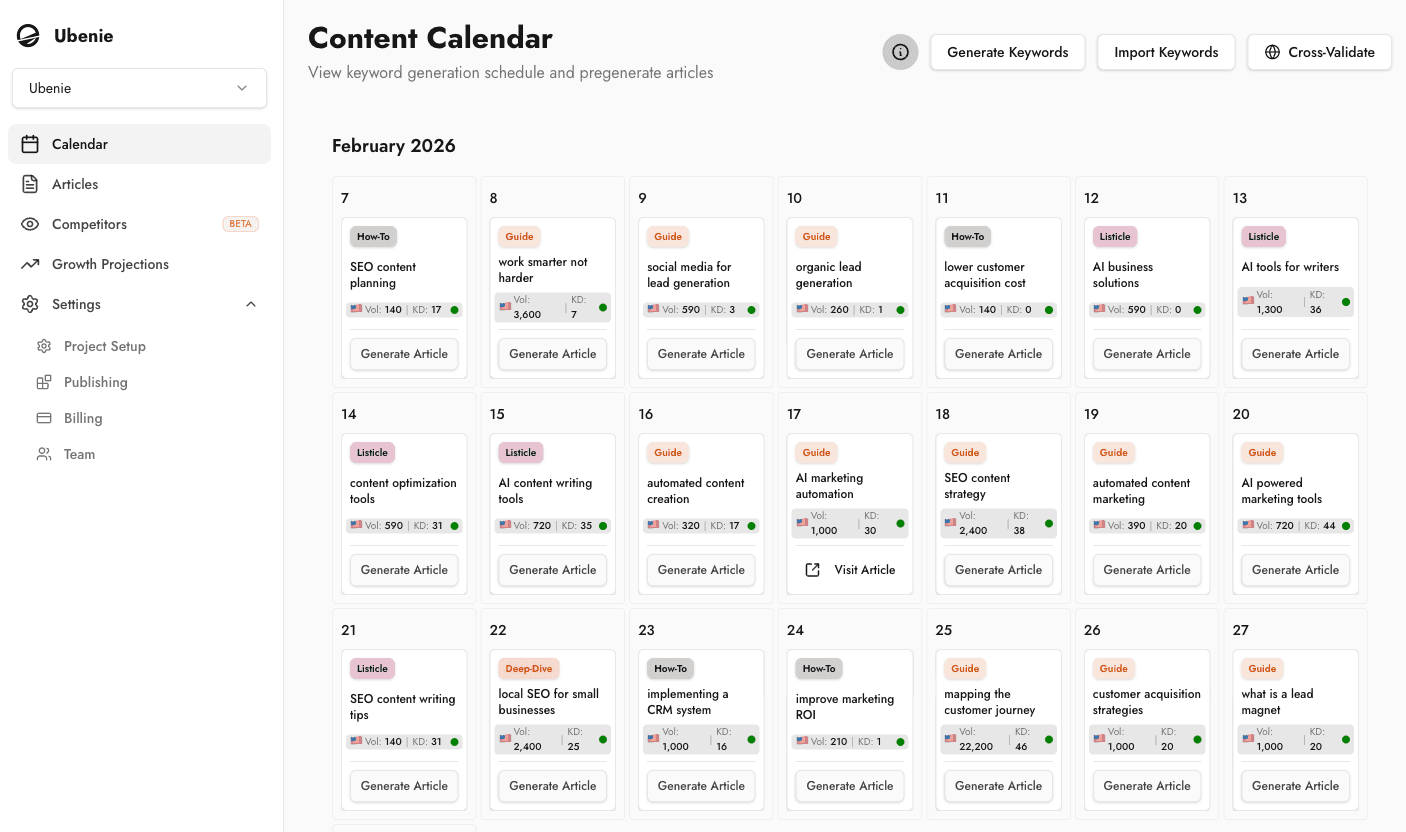
Once the AI understands your business, it identifies the best keyword opportunities. It prioritizes terms with high search volume and low competition, ensuring a clear path to the first page of Google. The platform then organizes these keywords into a logical content plan, creating a roadmap for your blog targeting customers at every buyer's journey stage.
Step 3: Automated Content Generation
This is where the magic happens. The platform transforms target keywords into complete, high-quality blog posts. It researches topics, structures articles for readability and SEO, writes compelling copy, and optimizes all necessary on-page elements. Draft articles appear in your dashboard, ready for review.
Step 4: Review, Tweak, and Approve
Automation doesn't mean losing control. You have the final say on everything published. Review AI-generated articles, make desired edits to inject your brand voice, and approve them. This collaborative approach combines AI speed and power with your human expertise, defining an efficient content workflow minimizing manual tasks while maximizing output.
Step 5: Schedule and Go Live
With a simple click, schedule approved articles to publish automatically on your blog. Build your content calendar for weeks or months, ensuring a consistent publishing schedule without last-minute scrambling. Your SEO content engine now runs on autopilot, consistently publishing optimized content to attract organic traffic.
Here's a simple checklist for getting started:
- Sign up for an automated SEO service like Ubenie.
- Complete the initial business profile with detail.
- Let the AI generate your initial keyword plan and content ideas.
- Review the first batch of AI-generated articles.
- Make minor edits to align with your brand voice.
- Schedule your first month of content.
- Monitor your analytics to track traffic growth.
The Evolving Landscape of Automated SEO
While AI-driven content generation is the most visible aspect of automated SEO services, the technology's potential extends far beyond writing blog posts. The future of SEO automation involves creating a fully integrated system that optimizes every facet of your online presence. This makes your website a more powerful and efficient marketing asset. As AI technology evolves, we can expect even more sophisticated automation capabilities for businesses of all sizes.
One next frontier is technical SEO automation. Imagine a system that not only detects crawl errors or slow page speeds but automatically implements fixes. This could involve optimizing image file sizes, minifying code, or implementing structured data to help your pages earn rich results. This would entirely remove one of the most intimidating and jargon-heavy aspects of SEO from your to-do list.
Local SEO is another area ripe for automation. For businesses relying on local customers, managing online listings across dozens of directories (e.g., Google Business Profile, Yelp) is tedious but essential. Automated services could ensure consistent business name, address, and phone number (NAP) data, respond to reviews using AI, and even generate localized content to attract nearby customers.
Ultimately, the vision is a holistic platform where AI not only creates content but also analyzes performance, identifies new opportunities, and self-optimizes the strategy. It could re-optimize old posts, suggest internal linking improvements, and provide predictive analytics on trending topics. This creates a virtuous cycle of continuous improvement, all running in the background. Platforms like Ubenie are building towards this future, providing a single, intelligent hub for all your SEO needs.
Conclusion: Achieving Effortless Organic Growth
The old way of doing SEO is broken for small business owners and marketing managers who cannot dedicate thousands of dollars or dozens of hours weekly. The manual grind of keyword research, content creation, and constant optimization is an unsustainable model leading to burnout with minimal results. The choice between exorbitant agency fees and an overwhelming DIY approach has left too many businesses digitally stagnant.
Automated SEO services represent a fundamental paradigm shift. By leveraging artificial intelligence, platforms like Ubenie democratize access to effective, scalable SEO. They transform the process from a complex, resource-intensive chore into a streamlined, automated workflow. This isn't about replacing human strategy with robots; it's about empowering business owners with a tool that executes strategy with previously unimaginable speed and consistency. It's truly one of the 7 smart & affordable SEO services that actually work.
By automating the heavy lifting of content creation and optimization, you are freed to focus on what matters most: serving your customers and growing your business. The future of SEO isn't about working harder; it's about working smarter. With automation, you finally have a co-pilot to navigate the path to sustainable organic growth.
Frequently Asked Questions
Are automated SEO services a replacement for human SEO experts?
For many small businesses, yes, automated SEO services replace the need for an agency or in-house expert. They handle time-consuming tasks like keyword research, content creation, and on-page optimization. While human strategists remain valuable for complex enterprise campaigns, automation platforms provide significant growth power for most businesses.
How long does it take to see results from automated SEO?
SEO is a long-term strategy, whether automated or manual. You can typically expect initial results, such as increased keyword rankings and organic traffic, within 3 to 6 months. The key benefit of automation is consistency; regularly publishing high-quality content builds momentum faster, leading to more significant results over time.
Is AI-generated content good for SEO?
Yes, modern AI-generated content is highly effective for SEO when done correctly. Platforms like Ubenie use sophisticated AI that produces well-researched, human-like, and engaging content. This content is specifically structured to rank on search engines. Google rewards high-quality content regardless of its production method, and these systems are designed to meet that quality bar.
What is the difference between an SEO tool and an an automated SEO service?
An SEO tool (e.g., Semrush, Ahrefs) provides data, requiring you to perform the analysis, strategy, and execution. An automated SEO service (e.g., Ubenie) is an end-to-end platform. It handles the entire process—from keyword discovery and content creation to publishing and optimization—with minimal input required from you.
Can I edit the content that the AI creates?
Absolutely. Reputable automated SEO services always give you final say. You can review every article the AI generates, make edits to match your brand's specific voice or add personal anecdotes, and only approve what you're 100% happy with. This allows for a perfect blend of AI efficiency and human oversight.
Tired of struggling with SEO and content marketing? Automate your traffic growth and focus on what you do best. Visit our website to discover how we can help you achieve higher search rankings and more leads.
Article created using Ubenie.